🛒 Using OCR and Vision Models to Ingest Grocery Price Data
November 22, 2024
Update May 2025: This whole blog post now only describes my first step in a 2-step process. I use the methods below for maximum accuracy in item detection, price detection, metadata and initial item-price pairings. But AI vision models have now gotten good enough to run a post-OCR "document placement sanity check." Given the original image and the information from the first step, vision models like the latest Gemini Pro can confidently determine whether the item-price pairings make sense. If all the pairings from the first step make sense, great! If some don't, the model is asked to point out the mismatch(es) if they are confident in what needs correcting. In the rare case the model is unable to give a confident answer, I eliminate the the item/price pair from the final record. (I figure is better to have 99 perfectly accurate product prices than 100 prices where there's a 1% chance of inaccuracy).
With this extra step, involving an extra API call, the receipt upload sequence takes longer. As a result, it is no longer acceptable UX to have the interface wait for a single long-running process. This is where Server-Sent Events have shined! The user's job is done when they click the upload button. The server's 'job' then starts, and pings the client in a one-way connection with event emitters until completion or failure. It's great that server job progress does not depend on the state of the user client, so users can feel free to close the web app or have temporary connection issues, both reasonably-likely scenarios if someone is taking pictures at a grocery store or on the move.
State of the Vision and OCR Models, Late 2024
For the past 2.5 months I have been building a progressive web app called OpenPriceData.com (a.k.a CPIPal.com, a.k.a. OpenPriceHistory.com, still haven’t really decided what sounds best). I did a little summer research on Computer Vision models during undergraduate CS, but am far from an expert. So, what does a software developer do when faced with a need for many types of image processing? Turn to existing models. Specifically, I need to:
- Parse store information and prices and names of items from a receipt.
- Detect UPC/EAN barcodes of those items.
- Infer product information (brand, weight/volume, catagory) from an item picture.
With those needs in mind (mostly the receipt use case, and similar but not fully TBD on the other two), here is my take on the state of vision and OCR models.
AI Vision Models
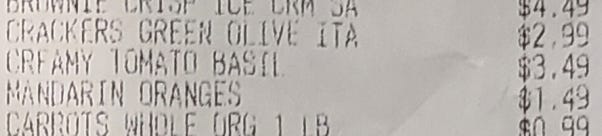
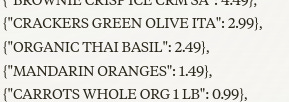
Thinking it would be super simple to just send API calls with base64 images and some prompt requesting a certain structure back for parsed data, I did a quick test of Anthropic (Claude 3.5 Sonnet) and OpenAI (GPT 4o).
Claude:
4o:
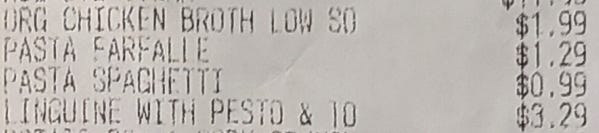
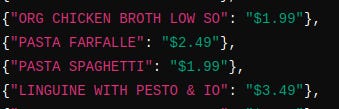
Out of the box, they both do surprisingly well, actually!
As in, they both get ~90% of the items/prices right. The problem is, when mistakes occur, they are major. Claude hallucinates a product text identifier when it can't figure one out, and 4o hallucinates some prices. The hallucinations are based on vibes, detached from underlying text. This is no problem at all for inferring information from product labels, and might actually be an asset, making it the winner for that use case. But for receipt text, if it’s not exact, it’s wrong.
They're also both the most expensive of all the real options available. I learned the cheaper and more "proper" way of doing receipt parsing is running more specialized OCR models. The two I tried out are Tessaract and EasyOCR.
Base Optical Character Recognition
The problem here, is that out of the box, they're both very dumb. By out of the box, I mean with out any fine tuning or other post-training adjustments, considering both projects state they are already very well optimized with receipts in mind. I did do the standard basic greatest hits of image processing when applicable - rescaling, grayscaling, rotating, and context hinting.
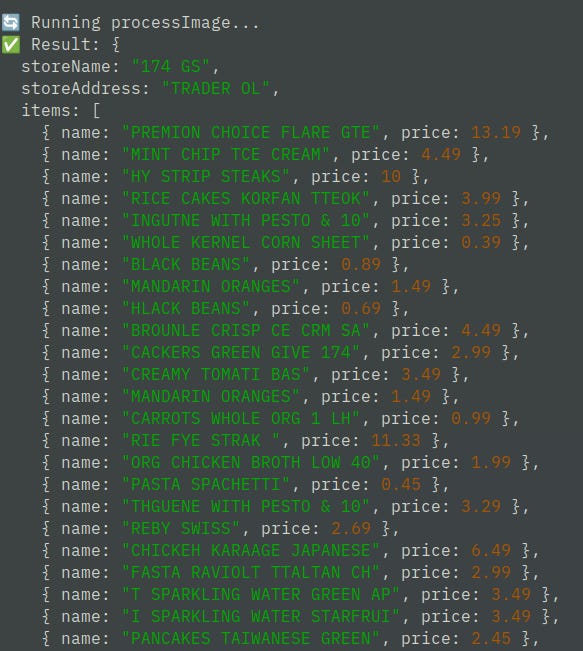
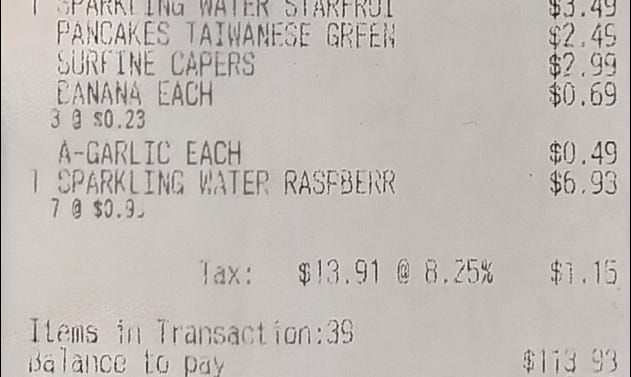
Here is the tessaract result after image processing:
And here’s the EasyOCR result using the online demo, which appears to do its own image processing:
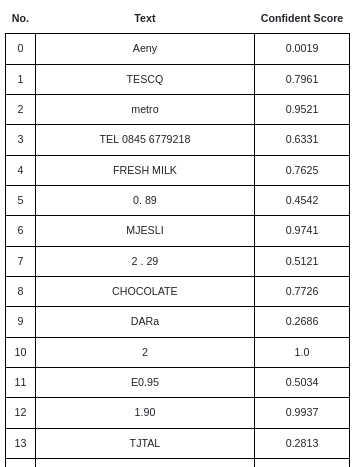
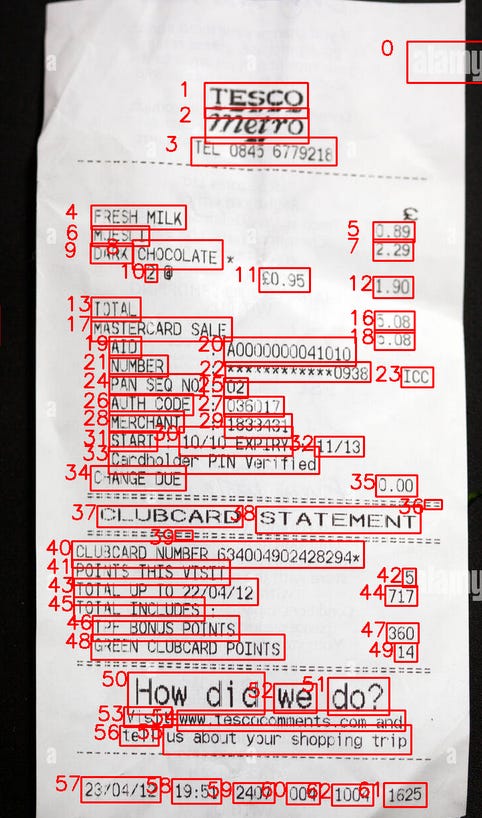
Overall, there’s just too great a distance between what these OCR models produce, and the level of exactness I need in my app’s DB in order for data transformation to be consistently fruitful at this stage.
Cloud Vision API (Google)
one billing and credential rabbit hole later...
There's another service I tried, but almost didn't, because of how much of a pain it is to enter the ecosystem. I'm talking about Google (specifically Cloud Vision API, though it was too hard to figure out to use that one, and their AI "solution generator" steered me wrong!)
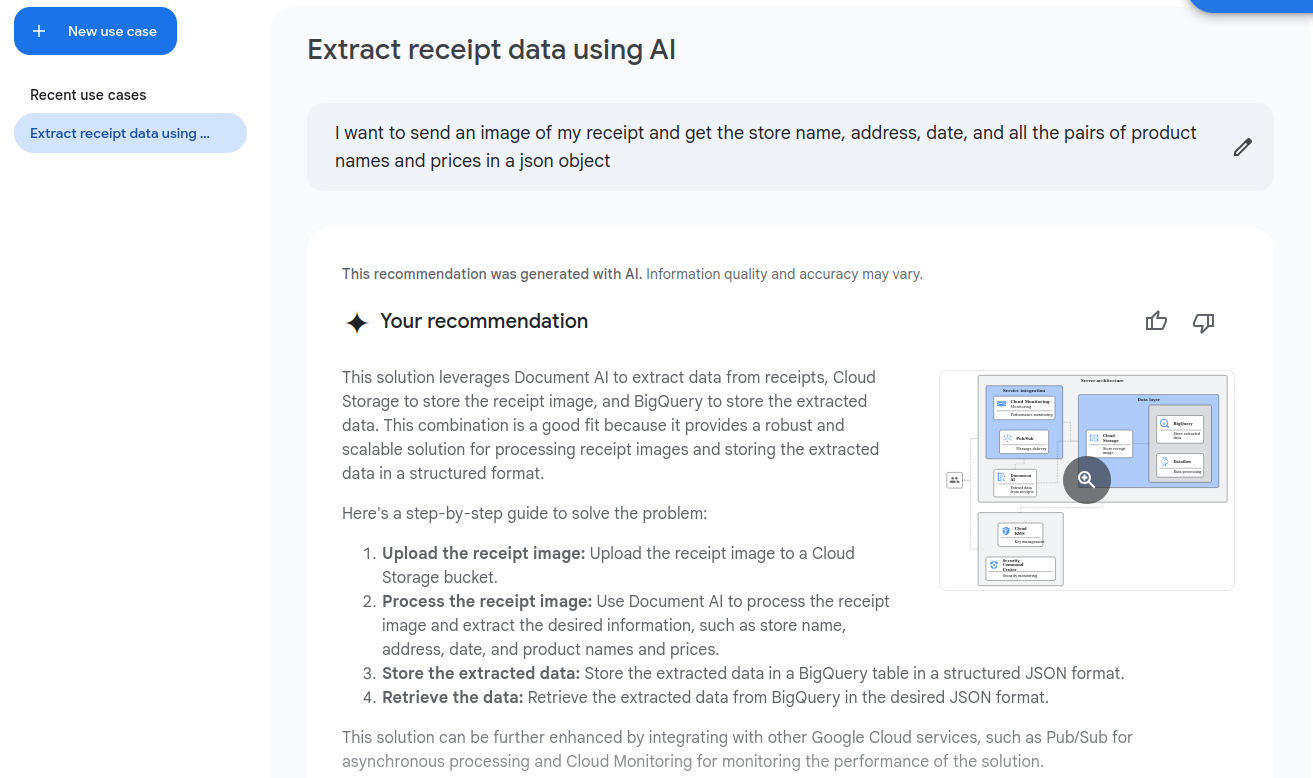
Have I mentioned it’s really hard to get set up, with needless barriers aplenty? Why does Google feel so beauracratic? It’s really sad to see such dissuasion towards new users, considering what I’m about to say next:
(Maybe it's my sunk cost bias showing, but) It's actually very impressive! It one-shot the test image with 99+% accuracy! And it looks to be the most extensible now that I’m in the ecosystem, showing the most promise for barcode detection as well.
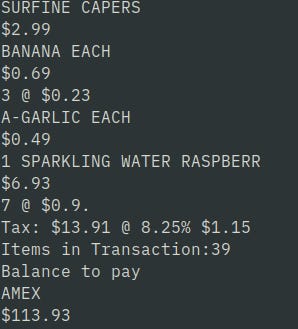
So, what am I to do?
Google Cloud Vision API is good enough to be serviceable to me, right now, as is. Until I get my app built out and magically have enough free engineering hours to roll my own ~everything~. So I'm using it.
But, as a matter of principle as a software dev I don't want to lock myself into a Google product (or any third-party service for that matter). This dilemma begs many questions, and I take my shot at answering a few of them now.
Q&A
Is it worth it to start back from EasyOCR, and train and fine-tune it for specific receipt formats? Maybe build a db for fuzzy matching?
At some point, yes, but only if the site takes off and I believe building a better model is possible.
Will generalist AI vision models get good enough to make bare OCR irrelevant?
I think so. The current vibe-y hallucinations are unacceptable for truth-critical systems, but I suspect we'll soon see models fall-back on OCR if low-confidence. & then soon after, no longer need to.
In sharing receipt data, why have the intermediate vision step anyways?
This is the most important question IMO. QR code summaries, receipts being emailed to payment card emails on file, or even point of sale systems talking directly to budgeting apps, for example, are all less lossy, more efficient, and easy to make more accessible. Computer-Computer interaction seems like the obvious necessity in this case, but no one's building it. It's a massive infrastructure project with no incentives for coordination. I'm hoping what I'm building with this intermediate tool can service consumers while highlighting the problem. This is a step in the right direction.
Follow my attempt to build this with the Open Price History App here! The app is live at openpricedata.com. It is wholly self and reader-supported.